7 Ways How to Make Money on Pinterest
Published
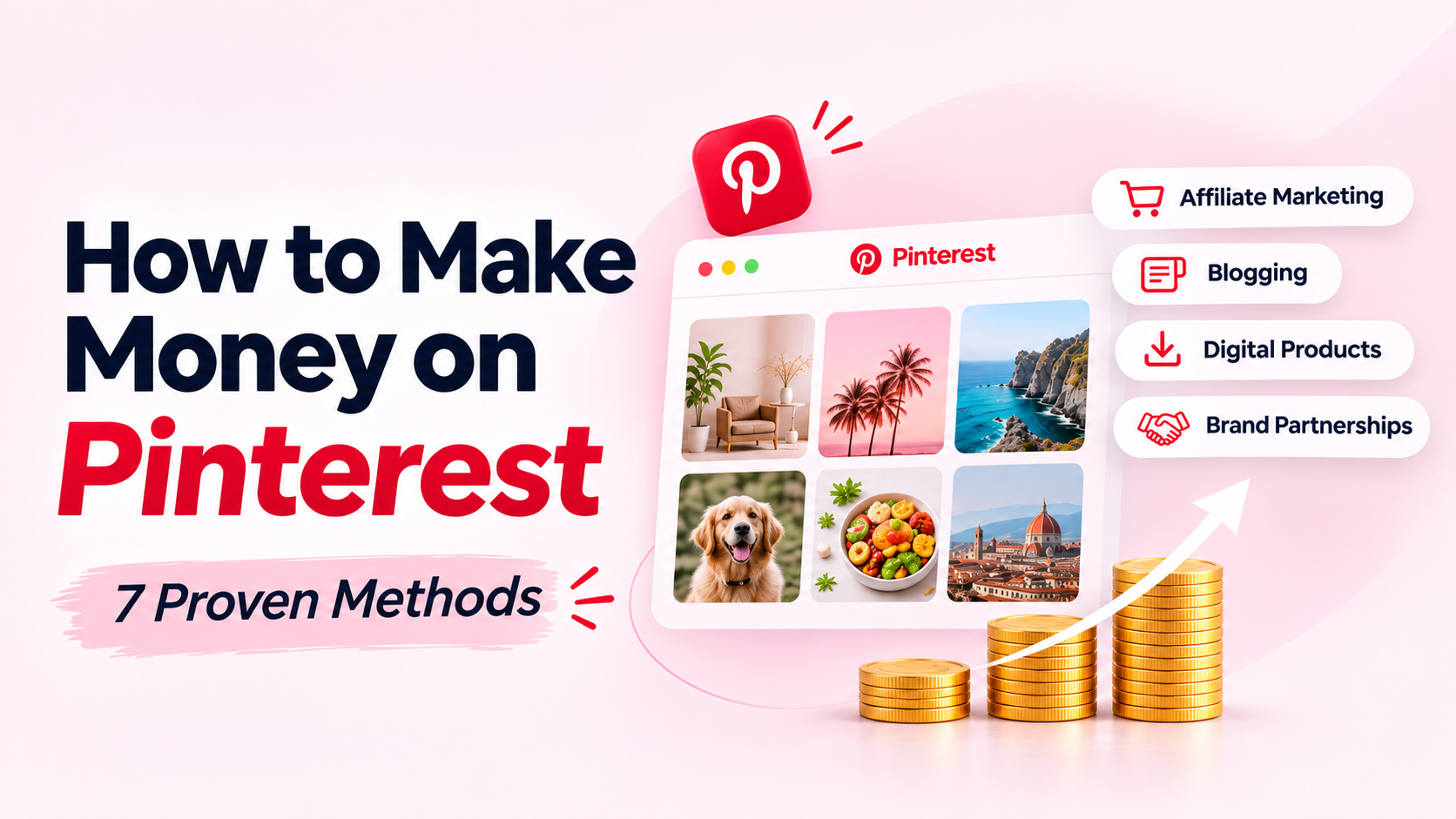
If you've ever wondered how to make money on Pinterest, you're not alone. Millions of people use Pinterest to discover recipes, home decor ideas, fashion inspiration, and products. But what many don't realize is that this visual discovery platform can also become a source of income.
The good news is that learning how to make money on Pinterest doesn't require thousands of followers, expensive equipment, or years of experience. You can earn through affiliate marketing, blogging, digital products, and several other methods.
However, there's one important distinction: Pinterest generally doesn't pay you simply for uploading Pins or receiving views. Instead, you earn by turning Pinterest traffic into sales, commissions, advertising revenue, or customers.
In this guide, we'll explore seven practical ways to generate income, how each method works, and how to get started even if you're completely new to Pinterest.
Can You Really Make Money on Pinterest?
Yes, you can make money on Pinterest, but understanding where that money comes from is essential. Unlike platforms that offer direct creator payouts for certain content, Pinterest primarily helps people discover products, ideas, and businesses. Creators can use that discovery process to attract potential customers to websites, online stores, and affiliate offers.
For example, imagine you run a food blog. You publish a recipe for homemade cinnamon rolls and create an attractive Pinterest Pin linking to that recipe. Someone searching for breakfast ideas discovers your Pin and visits your website.
If your blog displays advertisements, that visit may contribute to your advertising revenue. If the reader purchases a recommended kitchen product through an affiliate link, you might also receive a commission.
That's the basic principle behind monetizing Pinterest traffic.
Does Pinterest Pay You for Views?
No, Pinterest does not generally pay creators a fixed amount per Pin view, impression, or save.
Pinterest previously operated a Creator Rewards program, which offered payments for eligible content. However, the program ended in November 2022.
That means earning income through Pinterest typically involves an external monetization method rather than direct payments for ordinary Pins.
The distinction matters because a Pin receiving 100,000 impressions doesn't automatically generate revenue. What matters is how many people take meaningful actions after discovering your content.
7 Ways to Make Money on Pinterest
There isn't just one way to earn with Pinterest. Some methods require a website, while others involve selling products, promoting affiliate offers, or providing services.
Here's a quick comparison of seven monetization strategies:
Method | What You Need | How You Earn |
Affiliate marketing | Affiliate program and original Pins | Sales commissions |
Blogging | Website with useful content | Display ads and affiliate income |
Digital products | A product and selling platform | Product sales |
Online store | Physical products and storefront | Retail sales |
Sponsored content | Relevant audience and brand partnerships | Sponsorship fees |
Pinterest management | Pinterest marketing skills | Client payments |
Business promotion | Your own business or service | Leads and customer purchases |
1. Make Money With Pinterest Affiliate Marketing
Affiliate marketing is one of the most accessible ways to start earning without creating your own products.
The process is straightforward: you join an affiliate program, recommend relevant products, and receive a commission when someone completes a qualifying purchase through your tracking link.
For example, suppose you create Pinterest content about organizing small apartments.
You could recommend storage baskets, shelving units, kitchen organizers, or other products that help people maximize limited space.
When someone clicks your affiliate link and makes a qualifying purchase, the affiliate program credits you with a commission.
How to get started:
Choose a niche with products people actively search for.
Join an affiliate program that accepts your traffic source.
Find products relevant to your audience.
Create original Pins that demonstrate the product's benefits.
Link to an eligible affiliate offer or helpful product review.
Monitor clicks, purchases, and commissions.
Popular affiliate networks include Amazon Associates, Awin, CJ Affiliate, and Impact. Each program has its own requirements, commission rates, and rules about direct linking from Pinterest.
Important: Pinterest permits affiliate content under its Commercial and Branded Content Guidelines, but requires transparency, original value, and compliance with its anti-spam policies. Affiliate programs may impose additional restrictions.
If you're exploring how to make money from Pinterest through affiliate marketing, don't focus exclusively on high commissions. Products that genuinely solve problems for your audience are more likely to generate useful engagement and conversions.
For US audiences, affiliate relationships also need clear, conspicuous disclosures. A simple statement such as "I may earn a commission if you purchase through this link" communicates the relationship more clearly than an unexplained affiliate label.
2. Drive Pinterest Traffic to a Blog
Blogging is another popular Pinterest monetization strategy, especially in visual niches such as food, crafts, travel, home decor, gardening, and DIY.
Instead of linking directly to a product, your Pins send visitors to helpful articles on your website.
You can then monetize those visits through display advertising, affiliate marketing, or your own products.
Let's say you publish a recipe blog with articles such as:
Easy Banana Bread Recipe for Beginners
15 Budget-Friendly Dinner Ideas
Homemade Cinnamon Rolls Without a Mixer
Healthy Breakfast Meal Prep for Busy Mornings
Each article can have one or more original Pinterest graphics showing the finished dish and explaining what readers will learn.
When someone discovers a Pin and visits the recipe, they may view advertisements or purchase recommended cooking equipment.
How Much Can a Pinterest Blog Earn?
Blog revenue depends on traffic, audience location, ad rates, niche, and other factors.
For example, imagine your blog receives 50,000 monthly sessions from Pinterest and other sources. If its session RPM (revenue per 1,000 sessions) averages $15, the estimated advertising revenue would be:
50,000 ÷ 1,000 × $15 = $750 per month
This is a hypothetical calculation, not a typical or guaranteed result.
Some blogs earn substantially less, while others generate more because of their audience, advertising arrangements, and content.
The biggest advantage is that an article can continue attracting visitors long after publication, provided the content remains relevant and discoverable.
However, building a profitable blog takes work. You'll need original content, a functioning website, a monetization partner, and a consistent process for attracting visitors.
For beginners researching how to make money using Pinterest, blogging can be particularly appealing because it allows several income sources to work together.
3. Sell Digital Products
Digital products offer another monetization opportunity because you can create an item once and sell it repeatedly without maintaining physical inventory.
Examples include:
Printable budget planners
Wedding planning templates
Digital calendars
Educational worksheets
Resume templates
Printable wall art
Meal planning spreadsheets
Digital journals
Imagine you create a printable weekly meal planner and sell it for $9.
You could design Pins showing how the planner works, who it's for, and how it helps families organize meals.
When someone clicks through and purchases the planner, you earn revenue from the sale, minus transaction fees and other expenses.
Selling 50 planners at $9 each would produce $450 in gross sales.
The key is choosing products that match what Pinterest users are already looking for.
A random digital product is unlikely to sell simply because you post it on Pinterest. However, a useful solution to a specific problem has a clearer path to generating sales.
You can sell digital products through platforms such as Etsy, Gumroad, or your own website. Compare fees, customer experience, and product restrictions before choosing a platform.
4. Promote an Etsy Shop or Online Store
Pinterest can also help online sellers introduce their products to potential customers.
Because people frequently use Pinterest while planning purchases, visually appealing products can fit naturally into the platform.
For example, an Etsy seller offering handmade ceramic mugs could publish Pins featuring:
Minimalist coffee mugs for home offices
Handmade pottery gift ideas
Cozy kitchen accessories
Personalized ceramic gifts
Each Pin could direct interested shoppers to an appropriate product page.
The same strategy applies to Shopify stores and other e-commerce websites.
Successful product Pins should show the actual item clearly, communicate its purpose, and lead to a relevant page where people can learn more or purchase it.
Avoid misleading graphics, exaggerated claims, or linking to unrelated products.
Pinterest also offers business and merchant features that can help eligible stores present product information. Availability and requirements depend on your business setup and location.
For online sellers, Pinterest is particularly useful as an additional discovery channel rather than a replacement for an existing marketing strategy.
5. Earn Through Sponsored Pins and Brand Partnerships
If you create content for a specific audience, brands may be willing to pay you to feature their products.
For example, a Pinterest creator focused on home organization could partner with a company selling storage products.
The creator might produce original photographs, styled product images, or an instructional Pin demonstrating how to organize a pantry.
In exchange, the brand could pay a fixed fee or offer another agreed form of compensation.
The amount depends on factors such as your audience, content quality, campaign requirements, usage rights, and the value you provide.
You don't necessarily need a massive following. A smaller audience interested in a specific category may still be attractive to a suitable brand.
However, you do need evidence that your content reaches the intended audience and provides value.
Pinterest provides a paid partnership feature for eligible creators. According to its official documentation, creators establish brand partnerships outside Pinterest and can then apply a paid partnership label to the relevant Pin.
Always disclose paid relationships appropriately. Sponsorships should also comply with applicable advertising regulations.
6. Offer Pinterest Management Services
Not every Pinterest income strategy requires your own website, products, or audience.
You can also earn money by helping other businesses manage their Pinterest presence.
Many companies need assistance with content creation, keyword research, account organization, and performance analysis.
As a Pinterest manager, you might provide services such as:
Pinterest account setup and optimization
Keyword research for Pins and boards
Creating Pinterest graphics
Writing optimized Pin titles and descriptions
Organizing boards
Developing content calendars
Reviewing Pinterest Analytics
Monitoring traffic and conversions
For example, you might charge a client $300 per month for a clearly defined Pinterest management package.
Working with three clients at that rate would generate $900 in monthly gross service revenue.
These numbers are illustrative, not suggested market rates. Actual pricing depends on experience, deliverables, and client requirements.
You can find potential clients through freelance marketplaces, professional networking, and direct outreach to businesses that could benefit from Pinterest.
This method may be especially attractive if you already understand digital marketing, graphic design, or content strategy.
Unlike affiliate marketing, you don't need to wait for your own Pinterest traffic to generate sales. You're being paid for the work you perform.
7. Promote Your Own Business or Services
Pinterest isn't limited to creators selling physical or digital products.
It can also help promote service-based businesses, educational resources, and software.
For instance, a wedding photographer might publish Pins featuring wedding photography inspiration and link to their portfolio.
An interior designer could share room transformations and encourage visitors to explore design packages.
A software business could publish educational content addressing problems its product helps solve.
The goal is to attract people who are actively researching topics related to your business.
Instead of publishing promotional content exclusively, focus on providing useful information that encourages relevant visitors to explore your services.
If you offer a solution people are already searching for, Pinterest can become another source of qualified website traffic.
How to Make Money on Pinterest for Beginners: Step by Step
Now that you understand the available methods, let's look at how to make money on Pinterest for beginners without making the process unnecessarily complicated.
You don't need to pursue all seven strategies at once. In fact, choosing one method and testing it systematically is usually a better starting point.
Step 1. Choose a Profitable Niche
Start by selecting a subject you understand or are willing to learn about.
Popular Pinterest-friendly categories include food, home decor, fashion, beauty, gardening, crafts, weddings, and personal organization.
But popularity alone doesn't make a niche profitable.
Think about whether people searching for that content have problems to solve, products to buy, or projects to complete.
For example, someone looking for "small balcony garden ideas" might also be interested in planters, gardening tools, or downloadable planting guides.
That creates several possible monetization opportunities.
Try to choose a niche that combines search demand, commercial potential, and your ability to produce genuinely useful content.
Step 2. Create a Pinterest Business Account
A Pinterest business account gives you access to analytics and other tools designed for commercial use.
You can create a new business account or convert an existing personal account.
According to Pinterest Business, business accounts are free to create.
When setting up your profile:
Choose a recognizable business or creator name.
Add a clear profile picture or logo.
Write a description explaining your content.
Include your website, if applicable.
Create boards that match your main topics.
Your profile should help visitors immediately understand what kind of content they can expect.
Step 3. Research Pinterest Keywords
Pinterest functions as a visual discovery and search platform. That means understanding what people search for is essential.
Start typing a relevant phrase into Pinterest's search bar and examine the suggestions.
For example, if your niche is home organization, search for terms like "pantry organization" or "small closet ideas."
You may discover more specific topics people are interested in.
Pinterest Trends can also help you explore search interest and seasonal patterns in supported markets.
Use relevant keywords in your Pin titles, descriptions, and board information.
However, don't repeat the same phrase unnaturally or add unrelated keywords simply to attract impressions.
The goal is to help Pinterest understand your content and show it to people likely to find it useful.
Step 4. Create High-Quality Pins
Your Pin design plays an important role in attracting attention.
Pinterest recommends a 2:3 aspect ratio, such as 1000 × 1500 pixels, for standard image Pins.
You don't need professional photography equipment for every Pin, but the content should be clear, attractive, and relevant.
Effective Pins often include:
A high-quality image
Readable text that explains the topic
A clear benefit or takeaway
Consistent branding
An accurate link to the destination
For example, a Pin about a banana bread recipe could feature a photograph of the finished recipe and the text "Easy Banana Bread With 5 Ingredients."
That communicates what users can expect before they click.
Avoid copying other creators' images without permission. Original visuals and useful ideas are better foundations for a sustainable content strategy.
Step 5. Publish Consistently and Track Results
Once your account is ready, begin publishing Pins that connect your content to relevant searches.
You don't need to post dozens of Pins every day. Instead, establish a publishing schedule you can maintain while prioritizing original content. You could start by creating several useful Pins per week and evaluate how they perform.
Pinterest Analytics can help you monitor metrics such as impressions, saves, Pin clicks, and outbound clicks.
Pay special attention to outbound clicks when your monetization method depends on people visiting an external website.
For example, a Pin with 20,000 impressions and 20 outbound clicks may be less commercially useful than one with 5,000 impressions and 150 outbound clicks.
Review which topics attract visitors and whether those visitors take meaningful actions after leaving Pinterest.
Step 6. Optimize Your Monetization Strategy
Publishing Pins is only part of the process. You also need to understand what happens after someone clicks.
If you're promoting affiliate products, evaluate how many visits turn into purchases.
If you're driving traffic to a blog, monitor advertising revenue and affiliate conversions.
If you're selling digital products, look at conversion rates and sales.
You might discover that one topic attracts more visitors but another generates more revenue.
For example, general living room inspiration could produce thousands of impressions, while a specific Pin about choosing a space-saving sofa sends fewer but more purchase-ready visitors. Use that information to improve your content strategy.
Don't judge everything by impressions alone. The ultimate objective is to connect relevant content with a monetization method that works.
How Much Money Can You Make on Pinterest?
There's no fixed amount you can expect to earn from Pinterest.
Your income depends on the monetization method, traffic quality, conversion rates, commission structures, and the amount of work involved.
Some people generate no revenue, while others build profitable websites or businesses that receive traffic from Pinterest.
To illustrate how different approaches work, consider these hypothetical examples:
Monetization Method | Example Calculation | Gross Revenue |
Affiliate marketing | 100 qualifying sales × $5 commission | $500 |
Blog advertising | 50,000 sessions ÷ 1,000 × $10 RPM | $500 |
Digital products | 40 sales × $15 | $600 |
Pinterest management | 3 clients × $300 monthly | $900 |
Sponsored content | 2 partnerships × $250 | $500 |
These examples are calculations, not income benchmarks, predictions, or guarantees. Results vary significantly, and expenses, refunds, taxes, and other costs can reduce actual profit.
What Matters More Than Pinterest Impressions?
Consider two hypothetical Pinterest accounts.
Account A generates 100,000 monthly impressions but sends only 100 visitors to its website.
Account B generates 40,000 monthly impressions but sends 1,000 visitors.
If their traffic quality and conversion rates are similar, Account B has substantially more monetization opportunities despite having fewer impressions.
This is why your main performance indicators should reflect your business model.
For a blog, that might mean website sessions and advertising revenue.
For affiliate marketing, it could mean qualifying purchases and commissions.
For an online store, the most important indicators may be sales, conversion rate, and profit.
Pinterest impressions help measure visibility, but they don't tell the entire story.
Common Mistakes That Prevent You From Making Money on Pinterest
Pinterest monetization isn't always straightforward. Many beginners spend time creating content without developing a clear strategy for generating revenue.
Here are several mistakes worth avoiding.
Publishing Without a Monetization Plan
Before creating dozens of Pins, decide what action you want people to take. Are you trying to attract readers to a blog, sell a product, or generate inquiries for your services? Your content should support that objective.
Ignoring Search Intent
A beautifully designed Pin isn't necessarily useful if it doesn't match what people are searching for. Research relevant topics and create content that answers specific questions or solves problems.
Focusing Only on Impressions
High impression counts can be encouraging, but they don't guarantee earnings. Monitor outbound clicks, conversions, and revenue where applicable.
Reposting Duplicate or Irrelevant Content
Publishing repetitive Pins, misleading links, or irrelevant content can damage your account's performance and may violate Pinterest's spam policies. Prioritize original material and avoid practices designed to manipulate distribution.
Neglecting Old and Irrelevant Pins
Over time, your Pinterest account may accumulate Pins that no longer match your niche, brand, or business objectives. Reviewing your existing content can make account management easier, especially if you've changed your strategy.
If you have hundreds or thousands of Pins to remove, deleting them individually can become time-consuming. Tools such as PinDeleter allow you to select and delete multiple Pinterest Pins in bulk.
However, deleting older Pins doesn't automatically improve reach or earnings. Remove content when there's a genuine reason to do so, rather than assuming every underperforming Pin needs to disappear.
Frequently Asked Questions
Can You Make Money on Pinterest by Posting Pictures?
You can monetize original images by linking them to affiliate products, blog content, online stores, or other relevant offers.
For example, a photograph of a beautifully decorated bedroom could direct visitors to a blog featuring recommended furniture and home accessories. If someone makes a qualifying affiliate purchase, you may receive a commission.
Do People Make Money on Pinterest Without a Blog?
Yes. You don't need a blog to earn through Pinterest.
Alternative options include promoting eligible affiliate products, selling items through an Etsy shop, marketing digital downloads, providing Pinterest management services, and collaborating with brands.
How Many Followers Do You Need to Make Money on Pinterest?
Pinterest doesn't set a universal minimum follower count for earning money through external affiliate programs, online stores, or your own business.
Individual affiliate programs and brand partnerships may have their own eligibility requirements.
Can You Make Money on Pinterest Without Showing Your Face?
You can create Pins featuring recipes, products, illustrations, home decor, educational graphics, or other original visuals.
For example, a creator selling printable budget planners can promote the product through mockups, screenshots, and demonstrations without showing their face.
How Long Does It Take to Start Making Money on Pinterest?
There's no guaranteed timeline. Someone offering Pinterest management services might earn income after securing their first client, while a new blogger may need considerably more time to build traffic and qualify for advertising programs.
Results depend on your niche, existing audience, content quality, marketing skills, and monetization method.
Does Pinterest Pay You for Views?
No. Pinterest does not offer a general payment system that compensates creators for each view or impression. Its former Creator Rewards program ended in November 2022.
Can You Start Making Money on Pinterest for Free?
Yes, it is possible to get started without paying for Pinterest itself.
A Pinterest business account is free, and you can create original Pins using tools you already have.
However, some monetization methods involve additional costs. Running a website may require hosting, selling products may involve transaction fees, and professional design or marketing tools may have subscription charges.
Starting with free tools can help you test your approach before investing more money.
Start Making Money on Pinterest
Pinterest can become a valuable source of website traffic, customers, and sales, but success requires more than publishing attractive images.
Whether you choose affiliate marketing, blogging, digital products, e-commerce, or client services, the underlying principle remains the same: create useful content that reaches people interested in what you offer.
If you're just getting started, choose one monetization method, research your niche, create original Pins, and measure the results. Once you understand what works, you can expand your approach.
Learning how to make money on Pinterest is ultimately about building a repeatable process that turns discovery into meaningful business results. Start small, focus on quality, and give your strategy room to develop.